Published December 27, 2025 | Updated December 27, 2025

By MedCourse
Useful, relevant, and interesting content for UK Junior Doctors.
About the Author

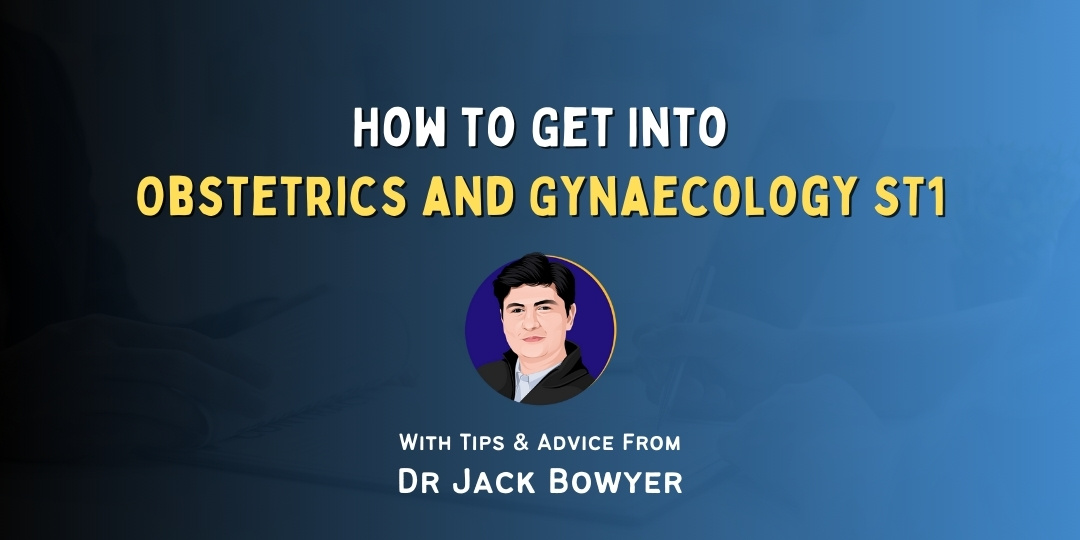
Dr Jack Bowyer MBBS MPH BSc (Hons) AFHEA,
ST1 Obstetrics and Gynaecology, Wessex
After finishing my BSc at KCL, I stayed on to study medicine as a graduate. As an FY2, I had protected time to work as a Public Health Fellow in Wessex. At the end of FY2, I travelled to the USA to complete an MPH at Harvard University in Health Management with a concentration in Maternal and Child Health. During my MPH, I worked part-time at a US-based maternal health-tech start-up and interned in the industry for 6 months, focused on women’s health research. After finishing my MPH, I worked full-time as a management consultant focused on life science/biotech projects before embarking on my speciality training in O&G. I continue to remain involved in industry work on a contract basis.
Courses & Conferences
To strengthen my application, I attended the Basic Practical Skills in Obstetrics and Gynaecology course, which is a requirement for trainees before commencing ST3. I also participated in my trust’s local PROMPT (Practical Obstetric Multi-Professional Training) course. I attended several conferences to present work, such as the RCOG Annual Academic Meeting and RCOG World Congress. Finally, I attended some research symposiums in the US during my post-FY2 year, where I received a grant as a Maternal and Child Health Leadership Fellow at Harvard.
If rotating in obstetrics and gynaecology, I would recommend reaching out to midwifery/labour ward colleagues to see if attending PROMPT would be possible. It’s free, includes simulations and is relevant to working as a trainee. Attending the RCS Basic Surgical Skills or RCOG Basic Practical Skills in O&G courses is a useful place to become familiar with surgical essentials like suturing/knots. As for conferences, the RCOG Annual Academic Meeting is a great place to present research/audit work.



How to Maximise Your Portfolio
The O&G interview is structured and transparent in its demands, which is something prospective applicants should use to their advantage. Applicants will be judged on QIP involvement, research projects, teaching roles, and leadership positions. For QIPs, I would approach your local O&G department, but it is not necessary for these to be O&G-specific. Focus on completing a robust project, presenting at a local/regional safety conference, and closing an audit loop.
Similarly, for research, I would recommend approaching academics at your nearest major research hospital/university and being picky about what you get involved with. Be transparent about your needs (recognition for your work via poster/oral presentation/publication) and find a supervisor who invests in you. Teaching is something we all do as students/foundation doctors.
To formalise these experiences, I recommend being diligent about gathering feedback and keeping a log. Next, I would use your records to consider applying for an AFHEA or other similar teaching qualification. Finally, the O&G interview asks for leadership beyond the clinical setting. I spoke about volunteer work I was involved in, but this is a great opportunity to stand out and show who you are beyond your academic credentials.
Making the Most of Your Day Job
Be opportunistic – particularly if you are based at a smaller DGH where research work is far and few between. Volunteer to deliver teaching as part of the foundation program lectures (bonus points if an O&G topic) or to rotating medical students. Make sure you receive feedback and keep it for your records. Similarly, take on local leadership positions and get involved in extra programs offered by your deanery. As a foundation doctor, I held a leadership position over junior doctor QIP allocation, which gave me access to hospital leaders at regular meetings. Moreover, I applied for a Wessex-based program to become a Public Health Fellow, which I highlighted during my ST interview. For O&G, I would advise organising a taster day if you have no rotation. I would also recommend showcasing a commitment to improving your surgical skills, whether at a course (use your study budget) or in an unrelated speciality. Finally, the RCOG has several prizes for projects/essays, which, although competitive, would make you stand out as an applicant.
Making the Most of Obstetrics and Gynaecology ST1 Placements
Strive to become familiar with a ‘normal’ obstetrics/labour ward, which is often best facilitated by speaking to the midwifery team.
Learn how to be an effective assistant in surgical theatres, particularly when assisting during caesarean sections.
Show that you’re keen to roll your sleeves up and get involved in procedures. Ask to be shown how to close after a caesarean section or do a perineal repair. O&G is full of procedures, and as an on-call SHO it can be easy to focus on your administrative tasks, but be opportunistic with your learning when you have the chance.
What About Non-Obstetrics and Gynaecology ST1 Placements?
People say O&G is a combination of surgery and medicine, so theoretically, there is much to learn from other specialities. If in a surgical speciality, become accustomed to the rules/norms in surgical theatres and basic surgical skills. As an SHO in O&G, you’re often going to be focused on the basic medical needs of patients and presentations of elevated blood pressure, infection, or hyperglycaemia will be commonplace. Moreover, there will be a clinical prioritisation exercise in the interview. Therefore, it is important to have these concepts under your belt whilst rotating on medical jobs.