Published December 27, 2025 | Updated December 27, 2025

By MedCourse
Useful, relevant, and interesting content for UK Junior Doctors.
About the Author

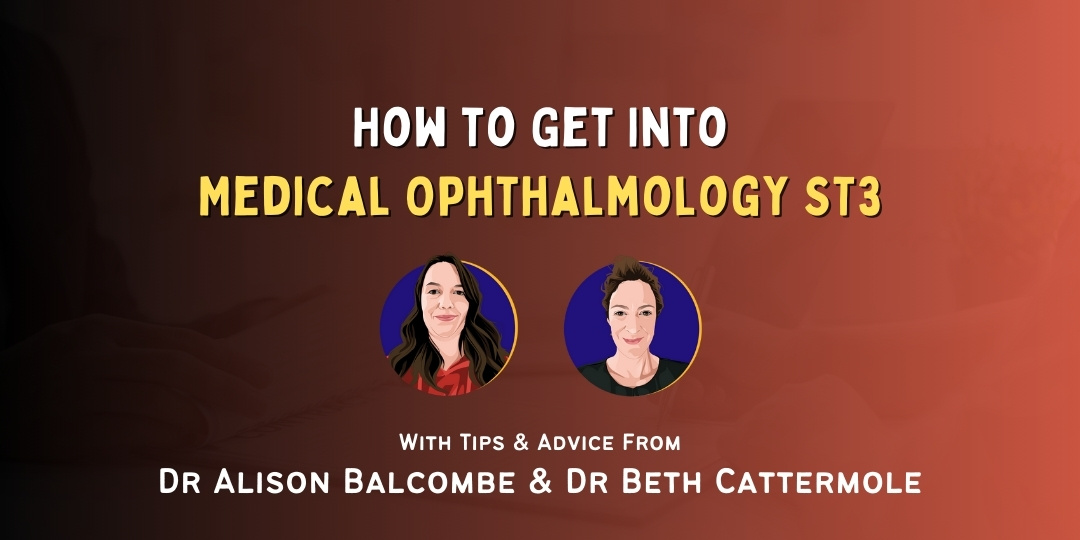
Dr Alison Balcombe, ST5 Medical Ophthalmology, Severn Deanery
During my intercalated degree in International Health, with a focus on eliminating preventable blindness, I developed a profound interest in Ophthalmology. Whilst in my ST2 year of Ophthalmology training, I realised my true passion lay in the medical management of ophthalmic conditions. Consequently, I reapplied for Medical Ophthalmology training, a decision that has proven to be both fulfilling and rewarding.

Dr Beth Cattermole, ST3 Medical Ophthalmology, Severn Deanery
I completed a Physics BSc, Medical Engineering MSc and worked as a research co-ordinator in stroke medicine prior to entering graduate entry medicine. After the foundation, I undertook an F3 year where I took locum shifts across all medical specialities before completing IMT years 1 and 2. I had a maternity leave year in the middle of IMT training and returned as an LTFT trainee. I have just started as an ST3 trainee in Medical Ophthalmology.
Courses & Conferences to Attend
- I attended the annual Medical Ophthalmology Society UK (MOSUK) and UK Neuro-Ophthalmology UK (UKNOS) meeting prior to my interview
- I also attended general medicine and neurology conferences, such as the RCP Med+ conference and the annual ABN conference
I would definitely try to attend the MOSUK annual conference; it is in the spring of each year. This gives an invaluable insight into the speciality as a whole. I learnt a lot about the speciality and what sort of patients are seen by medical ophthalmologists.
It was also an excellent opportunity to meet current registrars and consultants and ask them for their tips on the application and interview process. Given it is such a small speciality, I found it useful to discuss with them their perceived pros and cons of the speciality as well as their varied job plans – there are no IMT jobs in medical ophthalmology, and it is very different to inpatient medicine, so I found this aspect really helpful.


How to Maximise Your Portfolio
The key is to plan your application early and look at the Physician Higher Speciality Training Recruitment website for what domains score points in the application form. Even if you are undecided on your speciality, a lot of these points are generic, such as teaching or publications. Getting anything published is a lengthy process, for example, so starting early is key.
Ask senior colleagues how to get involved in QIP, research projects or teaching you may be interested in. Most deaneries have clinical education fellows who will be able to signpost you to teaching opportunities that may be available.
Obviously, QIPs, prizes or research within the medical ophthalmology field is an added benefit, but it is by no means essential as these skills are transferable.
I think the key to maximising your portfolio for medical ophthalmology is to attend relevant conferences and attend clinics or taster days where possible. This will give you the best feel of the speciality and if it is the right fit for you, as well as help when it comes to the interview with regards to the commitment to the speciality section.
If you are interested in teaching, consider attending the Teach the Teachers course. If you are a medical student, you could do the Duke of Elder exam to enhance your ophthalmic knowledge and confirm your interest in the speciality.
Making the Most of Your Day Job
The beauty of medical ophthalmology is that you see patients with a wide range of systemic diseases presenting with ocular symptoms; therefore, all medical rotations are useful. On any given ward, there will likely be many patients who have been seen by the ophthalmology services with a wide range of pathologies: glaucoma, diabetic retinopathy, uveitis, AMD or stroke, to name a few, if you look in their clinic notes. Borrow an ophthalmoscope and try to assess for any relevant pathology, and talk to the patient about their ophthalmic journey and treatment. Even becoming used to the terminology used is useful when in the interview and starting training.
Seek out ophthalmic presentations on the acute take, where you can, whether it’s new visual symptoms or headaches; there are plenty of patients who could have an ophthalmic cause for their presentation.
Making the Most of Medical Ophthalmology ST3 Placements
There is no medical ophthalmology rotation during foundation nor IMT, but the previous answer applies. You might be lucky and get an ophthalmology rotation in foundation training, in which case, be enthusiastic and get stuck in!
What About Non-Medical Ophthalmology ST3 Placements?
A lot of ophthalmology patients are, understandably, anxious about losing their vision. It can be a stressful time for them, and a doctor, in any speciality, should have good communication skills. Gaining a rapport with patients, listening to their concerns, being empathic to their situation and explaining your thought process and forward plans to them can be practised throughout training; in any speciality.
In addition, things like time management, prioritising patient load and organisational skills are all really important, and these skills are improved with time across all specialities. If you are enthusiastic and seek out opportunities, there are always things to be learnt. For example, on my T&O rotation, I did a shoulder injection, which improved my manual dexterity, which will be useful for performing procedures such as intravitreal injections in medical ophthalmology.
Offer to organise regular teaching sessions, even if they are not specifically ophthalmic related, will help develop general skills. Or become competent in fundoscopy, and you will become very popular if you are able to give small group teaching to the foundation doctors or IMT doctors