Published December 27, 2025 | Updated December 27, 2025

By MedCourse
Useful, relevant, and interesting content for UK Junior Doctors.
About the Author

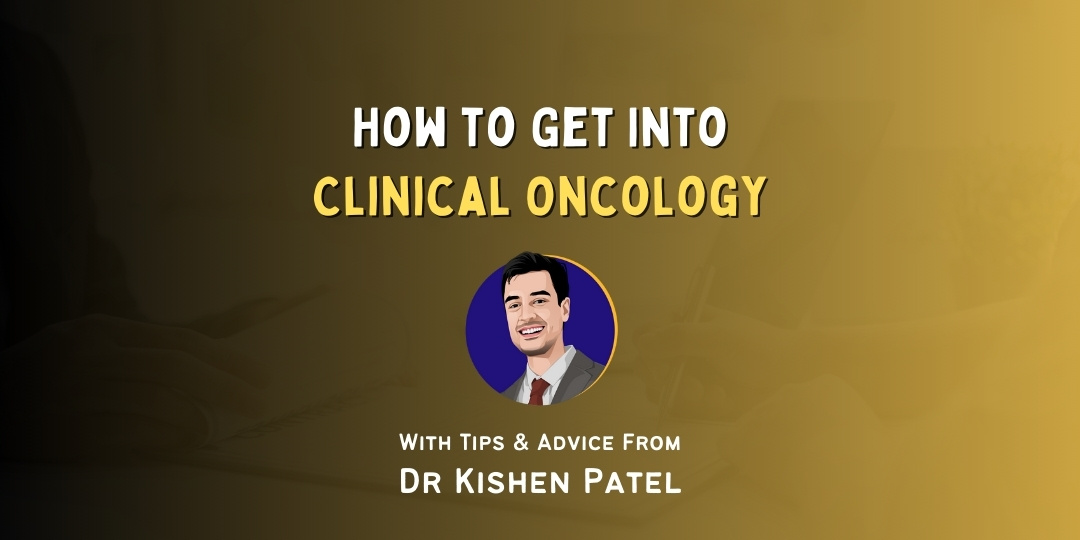
Dr Kishen Patel, Clinical Oncology Registrar, University College London Hospital
My initial interest in oncology as a career began during my medical elective at AstraZeneca, where I was placed in their oncology drug development team. After graduating from King’s College London Medical School in 2017, I completed foundation training in Birmingham with placements in Oncology. After completing Internal Medicine Training and MRCP, I applied for a Clinical Oncology Senior Clinical Fellowship role at St Bartholomew’s Hospital, which also funded a PGCert in Medical Education.
These experiences helped me to gain an academic training post in Clinical Oncology in 2022 in the North London Deanery. In addition to my clinical role, I am enrolled in an MSc in Oncology run by the Institute of Cancer Research.
Courses & Conferences to Attend
Prior to starting my speciality training, I have presented at various conferences, including the Royal College of Radiologists (RCR) annual conference, UKINETS, ENETs and the British Institute of Radiology AI conference.
The RCR annual conference is an excellent conference with many presentation opportunities that highlight a true interest in clinical oncology. Other conferences I would recommend include cancer site-specific conferences such as BTOG, BNOS, BUG, UKINETS, or UKBCG. An MSc in genomics, oncology, leadership, or medical education can also significantly strengthen an application.


How to Maximise Your Portfolio
Start early. To be awarded points for your speciality application, the publication, teaching program, or QIP needs to be complete, and make sure that the hard work you have done is useful for your application.
Make your own opportunities. There is a vast amount of cancer research that trainees can get involved with, which will significantly strengthen a training application. Email oncologists in your local area to ask about projects that you can get involved with and try to obtain oncology placements during your foundation and internal medicine training. If placements in oncology aren’t available, ensure you are utilising your study leave for taster weeks in the speciality.
Maximise each opportunity. After people have locally presented their QIP, they leave the project there. Often, with a relatively small amount of work, these projects could have been presented as a poster or written up as a publication. When involved in a QIP, inform your supervisor early that you are interested in writing it up as a publication; you’ll find most supervisors are happy to support and guide you through the process.
Complete the audit cycle once you have completed a QIP to be awarded maximum points; a further cycle needs to be completed.
Making the Most of Your Day Job
Gain experience in managing patients with cancer. In interviews, you will be asked about the management of oncological emergencies such as metastatic spinal cord compression, new brain metastasis, or acute chemotherapy reactions. Familiarise yourself with the local acute oncology guidance for management of oncological emergencies, and when possible, try to spend time with the AOS team.
In preparation for interviews, immerse yourself in the language of oncology. Be able to distinguish between neoadjuvant, adjuvant, and palliative cancer treatments, and develop a nuanced understanding of various systemic anticancer agents, including chemotherapy, immunotherapy, and targeted treatments. It is also useful to have a familiarity with the TNM staging criteria.
Making the Most of Clinical Oncology Placements
During a placement in oncology, express your interest in pursuing a career in this specialty to your seniors. Open communication about your aspirations fosters a supportive environment, often leading to assistance and guidance for your oncology applications.
Diversify your experiences during the placement to garner a comprehensive understanding of cancer care. Recognise that inpatient oncology represents just one aspect; therefore, allocate time to engage with various teams such as radiotherapy, acute oncology, and outpatient oncology. This well-rounded exposure will provide a reservoir of experiences to discuss during your interview, which highlight a strong commitment to the speciality.
What About Non-Clinical Oncology Placements?
When working in a different speciality, it can be harder to gain cancer experience; therefore, I would recommend using your taster weeks during these rotations. When possible, see cancer patients on ward rounds or clerking shifts and follow up on their progress during their admission.
However, when working in a different speciality, it is important to acknowledge that this could be your final experience in this field. Cancer affects all parts of the body; therefore, a well-rounded understanding of medicine is essential in an oncology career. Personally, I frequently draw upon skills acquired during my F1 psychiatry placement when managing cancer patients.