Published December 27, 2025 | Updated December 27, 2025

By MedCourse
Useful, relevant, and interesting content for UK Junior Doctors.
About the Author

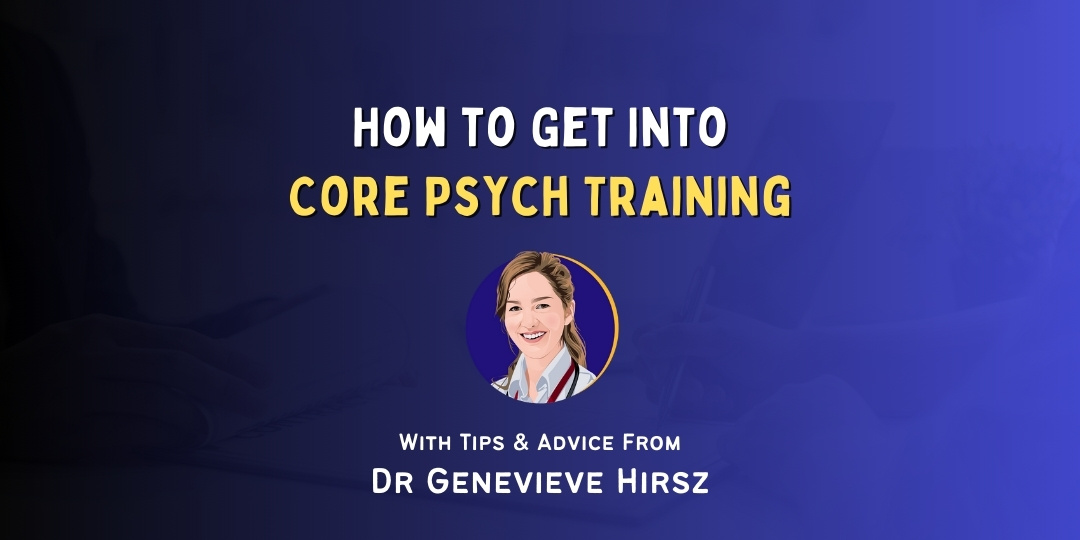
Dr Genevieve Hirsz, CT3, East London Foundation Trust.
I am a CT3, finishing my last rotation in East London Foundation Trust. Most mental health NHS trusts are paired, and I completed my first few rotations in the North East London Foundation Trust.
I’m interested in general psychiatry, and particular subspecialties such as early intervention in psychosis and perinatal.
Courses & Conferences
- I chose an F1/F2 training programme with a Psychiatry placement in F2. F1s are never on on-call rotas as they cannot complete the 5(2) Section paperwork. I also managed to get some interesting experience shadowing psychiatrists outside my ward through one of the consultants, including shadowing a psychiatrist in prison and a forensic psychiatrist in a medium secure unit!
- I was very lucky to complete a project using TMS (Transcranial Magnetic Stimulation) and tDCS (transcranial Direct Current Stimulation) and present at the Society for Neuroscience in Washington, DC, but this definitely wasn’t necessary. I found it personally interesting, but as it was only a poster presentation, it didn’t get me many points for SpR applications.
- In my foundation years, I attended courses for teaching, such as Teach the Teacher and the Cambridge QI National Conference.
- For the MSRA, I did 1 or 2 question banks and didn’t attend any extra revision courses.
- When I’ve asked consultants this, they always say to show you have an interest in Psychiatry. This is likely by contacting your local mental health team and finding out if there are opportunities for shadowing different teams (e.g., CAMHS, liaison, and an inpatient unit) whilst an F1 or F2.
- The conference I recommend to most juniors is the Institute of Psychiatry, Psychology and Neuroscience (IoPPN)’s summer school. It is usually during July, with application deadlines around March, but make sure to check in case it changes!
- Other courses that I did, such as Teach the Teacher, are helpful if you want to become an FME (Fellow in Medical Education) and for points when applying for SpR, but aren’t as important for the CT application, as it’s currently based only on MSRA.
- I didn’t go to any specific revision courses for MSRA and just used question banks.


How to Maximise Your Portfolio
Currently, your portfolio/CV doesn’t actually matter for CT applications as it’s all based on your MSRA score. However, it will matter once you become a SpR, and from personal experience, the experience I got during medical school and F1/F2 helped me with SpR applications too (although you could get them done during CT if you need to!)
Currently, you apply for higher training through a national programme, and you rank specific specialities (e.g. General, Forensics, LD, CAMHS, Psychotherapy, Old Age) after you’ve got a score (based on a 12-minute interview, self-assessment, and CASC, which is the practical exam. I would recommend looking at the HEE website for information about how to get points through the self-assessment system, as they are very specific. It’s split up into 10 domains, including research, teaching, and leadership. Look out for opportunities such as a QI project or audit as soon as possible; being a rep for at least 6 months; and presenting at conferences (as a speaker, not just posters). Trainee conferences are much less intimidating and easier to present at, as you’re not necessarily competing against people who are presenting their whole PhD!
Making the Most of Your Day Job
The MSRA is really important, and not many questions are based on Psychiatry; so even if your heart is set on Psychiatry, don’t neglect your physical health knowledge for the MSRA! As a CT, you’re often covering the physical health of the psychiatry inpatient units, so you still need your physical health knowledge for that, too.
It’s not as important for CT, but for future applications, Psychiatrists love hearing if you have other interests such as art or philosophy, and there are interest groups in these areas from the Royal College of Psychiatrists. Have a look at their pages for courses or conferences to see if there’s something you might be doing outside of clinical practice anyway that you can nurture for the future. Don’t forget to use your study leave efficiently to attend courses, conferences, and shadow your local Psychiatry teams!
Making the Most of Core Psych Training Placements
Definitely ask your consultants if you can get experience in other subspecialties. Even if you don’t know what you like, this might be the first chance at seeing what community psychiatry or inpatient psychiatry looks like, or seeing acute liaison psychiatry.
What About Non-Core Psych Training Placements?
Although I knew I wanted to do Psychiatry, I still found it quite difficult to gain a huge amount of experience when in other jobs. Psychiatric patients often require a lot of time, which you usually don’t have in your daily job. That’s why it’s so important to make that time by arranging for these days with the Psychiatry team and away from your clinical work. Or you may be lucky and find a QI project that may be related!