Published December 27, 2025 | Updated December 27, 2025

By MedCourse
Useful, relevant, and interesting content for UK Junior Doctors.
About the Author

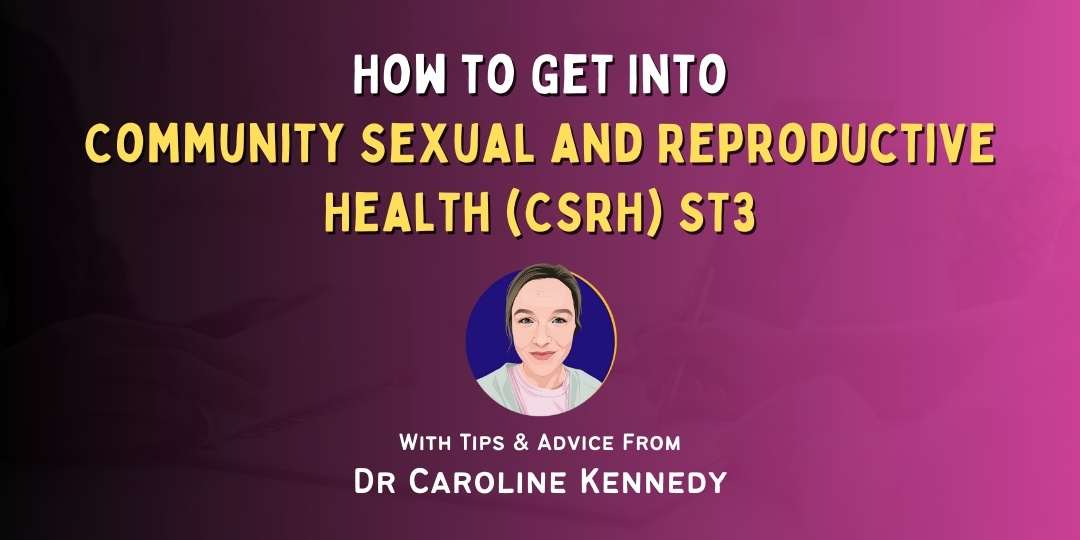
Dr Caroline Kennedy, Community Sexual and Reproductive Health (CSRH) ST3, Oxford University Hospitals NHS Foundation Trust.
I am currently a CSRH ST3 in Oxford and really enjoying the training programme. I always thought I wanted to work in women’s health, but did not decide on CSRH (or know about it!) until I was an F2. Following foundation training in Devon, I took a year out to travel, then undertook a clinical fellow post in Sexual and Reproductive Health (SRH) at The John Hunter Clinic in London before completing a master’s in reproductive and sexual health research at the London School of Hygiene and Tropical Medicine, before applying for CSRH training.
At present, I work across the integrated sexual health service, Early Pregnancy Unit and gynaecology service. Some of the projects I am currently working on within my training are developing the outreach services at the sexual health unit, developing the post-pregnancy contraception service on the gynaecology ward and developing a specialist menopause-oncology MDT – so very varied work!
Courses & Conferences
I heard about CSRH when attending a Royal College of Obstetrics and Gynaecology (RCOG) careers day as an F2. CSRH is very much intertwined with O&G and always has a presence at the RCOG career day, so this is a good event for medical students and junior doctors who are considering O&G or CSRH as a career to attend and meet some people in the speciality.
During my foundation years, I completed the BASHH STI foundation course, which was a great introduction to sexual health. Then, as a clinical fellow, I completed the Faculty of Sexual and Reproductive Health (FSRH) diploma as well as attending some FSRH teaching days and the annual British Association of Sexual Health and HIV (BASHH) conference. To do the diploma, you do need to have some time in an integrated sexual health department – but this could certainly be during an F1/F2 placement if you had a foundation job in sexual health.
CSRH encompasses community O&G, sexual health, public health, education and leadership. So, any leadership or teaching course is useful, but more specifically in terms of sexual and reproductive health (SRH), the following are a good place to start!
The FSRH hold regular teaching events as well as an annual conference which covers a wide scope of CSRH work and is also an excellent networking opportunity. They run an annual undergraduate essay competition too. Keep a close eye on their website throughout the year for events.
BASHH also hold regular teaching events – many are free – and an annual conference. They have the Student and Trainee Association for Sexual Health and HIV (STASHH) branch, which provides educational opportunities and career development support for people interested in sexual health.
RCOG is another useful website for educational events. Their abortion care essentials course is great. In terms of abortion care education, the British Society of Abortion Care Providers (BSACP) and Doctors for Choice offer many resources on their websites, too.


How to Maximise Your Portfolio
At the interview, they want to see interest in and commitment to the speciality, as well as experience in teaching, leadership and audit/QIP. So, this is what you need to fill your portfolio with!
Have a good example of an audit to discuss; it doesn’t necessarily need to be in SRH, but showing evidence of knowing and completing the audit cycle is what they will want to see.
In terms of research and teaching, easy things to do are presenting a research paper at a journal club meeting or giving a departmental talk on topics linked to SRH. BMJ SRH is a good journal to read.
To demonstrate Interest and commitment to the speciality, there are many things you can do. You can attend any of the courses, conferences and events mentioned above. You can get involved in student and undergraduate committees linked to Sexual Reproductive Health (SRH) or volunteer with organisations working on SRH rights. You can arrange some taster days in CSRH and reach out to current CSRH trainees and consultants to just learn more about the role and training programme.
Making the Most of Your Day Job
Making the Most of CSRH ST3 Placements
If you are working in a sexual health unit, put yourself forward to be involved in audits, QIPs and research. Working in an integrated GUM unit is also a brilliant time to do your DFSRH or letter of competency in implant or intrauterine contraceptive device fits, so ask about training in these areas early on.
If there is a CSRH trainee in your unit, speak with them about the training programme and get a good understanding of what it entails, the pros and the cons – this is often a topic which comes up in interviews!
If you are working in O&G, again get involved in projects going on – there will probably be some directly related to contraception and/or STIs. There may also be implant or intrauterine contraception fitters who can train you for your letter of competence in these areas. There is a diploma in O&G that is not necessary for FRSH, but is a good foundation for clinical work in community O&G and would help towards the MFSRH part 1 exam later on.
What About Non-CSRH ST3 Placements?
If you are in a different speciality, remember that many skills are transferable. CSRH involves discussing sensitive topics, empowering, educating, breaking bad news, and developing services – all of which you will be doing day to day as a doctor in any area of medicine. So, reflect on your experience in these areas and how the skills you are gathering elsewhere will benefit you in CSRH.
Just because you are not directly working in SRH, it does not mean it is not relevant in that speciality – in fact, SRH is almost always relevant! Therefore, think about how SRH is linked to the speciality you are in – STIs in pregnancy, menopause after surgery/cancer, sexual wellbeing after cancer, hormones and mental health, hormones and surgery – and consider any project work or teaching in these areas you can get involved with.
Top 3 Tips for Getting Into CSRH ST3
CSRH is a brilliant career choice – it is hugely varied in terms of clinical work, but also offers great training in management and leadership, and compared to other specialities, it does offer a nice work-life balance. So good luck in applying, and hopefully, see you at some FSRH events in the future!